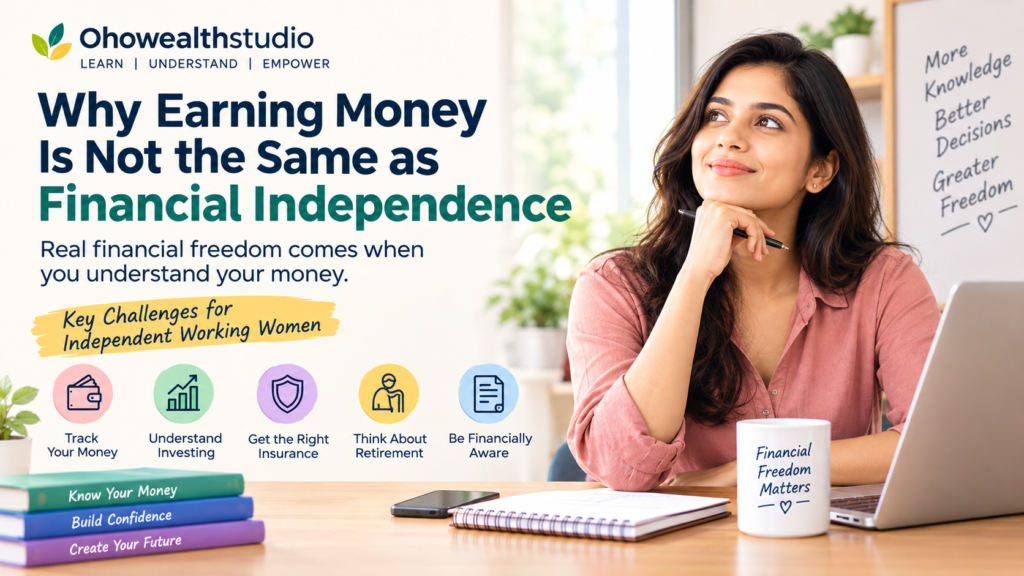
You earn your own money. You have a good career. You pay your bills. You may even contribute significantly to your family.
But ask yourself a slightly uncomfortable question:
If your salary stopped tomorrow, how financially comfortable would you really be?
Would you have enough savings to manage your expenses?
Would you know exactly where your family’s investments are?
Would you know how much insurance you have?
Would you understand your retirement savings?
Would you be comfortable making an important financial decision on your own?
For many independent working women in India, the answer to these questions is not as reassuring as they expect.
And this is where the difference between earning money and being financially independent becomes important.
A woman can have a successful career and still feel financially unprepared.
She can earn ₹1 lakh a month and still wonder where all the money goes.
She can invest every month and still not understand what she owns.
She can manage a household and still not know the family’s complete financial picture.
She can be professionally independent and yet financially dependent on someone else for important money decisions.
Financial independence begins when you don’t just earn money—you understand it.
The Real Financial Problems Independent Working Women Face
Today’s Indian working woman is juggling more responsibilities than ever.
She may be a corporate professional, entrepreneur, doctor, lawyer, teacher, freelancer, consultant, business owner or working mother.
She earns.
She saves.
She supports her family.
She may pay EMIs.
She may help her parents.
She may contribute to children’s education.
And somewhere in between meetings, deadlines, household responsibilities and personal commitments, her own financial future can get pushed down the priority list.
Let’s look at some of the problems that many working women can relate to.
“I earn well, but I don’t know where my money goes.”
Salary increases often bring lifestyle increases.
A bigger salary can mean a bigger house, better holidays, more shopping, higher subscriptions, more dining out and larger financial commitments.
At the end of the month, the question remains:
“Where did my salary go?”
Earning more is useful, but understanding where your money goes is equally important.
“I save, but I don’t know if I’m building enough wealth.”
Saving money and building long-term wealth are not necessarily the same thing.
Money may sit in a savings account.
It may be spread across different bank accounts.
It may be invested in different products without a clear understanding of why each investment exists.
A financially aware woman should be able to answer:
What am I saving for?
What am I investing for?
How much of my money is meant for the short term?
What is meant for the long term?
These are financial awareness questions—not simply investment questions.
“My husband or family member handles the investments.”
This is perhaps one of the most important financial conversations for women.
Many women are perfectly comfortable earning money but leave investment-related decisions entirely to their spouse, parents or another family member.
There is nothing wrong with sharing financial responsibilities.
The problem begins when one person understands everything and the other person understands nothing.
Every woman should know the basic financial picture of her household.
She should know what assets exist, what liabilities exist, what insurance is held and where important documents are maintained.
Financial independence does not mean doing everything yourself.
It means not being financially unaware.
“I’m financially independent now. I’ll think about retirement later.”
This is another common trap.
When you are 28, retirement can feel decades away.
When you are 35, there are children, home loans and career responsibilities.
At 45, retirement suddenly doesn’t seem quite so far away.
The earlier women start learning about retirement, inflation and long-term savings, the more time they have to understand the financial requirements of later life.
Retirement isn’t just an old-age problem.
It is a financial independence problem.
“What happens if I take a career break?”
Career breaks are common for many women.
Childcare, eldercare, relocation, marriage, education, entrepreneurship and personal circumstances can all affect a woman’s career.
A career break can also mean:
- Reduced income
- Reduced savings
- Interrupted retirement contributions
- Changes in insurance coverage
- Increased dependence on household income
This is why a woman’s financial life should not be built entirely around the assumption that she will earn the same income continuously for 30 or 40 years.
Understanding your finances can help you become more aware of these possibilities.
“I don’t have time to understand all this.”
This is perhaps the biggest problem of all.
Working women are busy.
Very busy.
There are careers to build, businesses to run, families to manage and lives to live.
Financial education often gets postponed because it doesn’t feel urgent.
Until suddenly it is.
The good news?
You don’t need to become a financial expert.
You simply need to understand the basics.
Financial Independence Is More Than Having a Salary
So what does financial independence for women actually mean?
It doesn’t necessarily mean becoming extremely wealthy.
It doesn’t mean having a particular salary.
And it doesn’t mean never depending on another person.
Financial independence can simply mean having enough financial awareness and personal resources to participate confidently in decisions about your financial life.
It can involve understanding:
- Your income
- Your expenses
- Your savings
- Your investments
- Your insurance
- Your loans
- Your financial documents
- Your retirement arrangements
- Your financial goals
- Your family’s major assets and liabilities
In simple words:
Financial independence means knowing what is happening with your money and having a voice in what happens next.
Why Financial Independence Is Especially Important for Indian Women
Women in India are increasingly participating in the workforce, building businesses and becoming financially independent.
But earning money is only the beginning.
Financial independence becomes stronger when women also develop financial literacy.
A financially aware woman can ask better questions.
Instead of:
“Is this investment good?”
She can ask:
“What is the risk?”
Instead of:
“How much return will I get?”
She can ask:
“What happens if the market falls?”
Instead of:
“Should I buy this product?”
She can ask:
“Why do I need it, what are the costs, and what are the risks?”
That change in thinking is powerful.
Financial Literacy for Women: The Basics Everyone Should Know
You don’t need to understand every financial product available in India.
Start with the fundamentals.
1. Budgeting
Know what comes in and what goes out.
A simple monthly money check can show you:
- Income
- Essential expenses
- Lifestyle expenses
- Debt payments
- Savings
- Investments
The objective is awareness.
2. Emergency Savings
Life doesn’t always follow the plan.
An emergency fund can provide a financial cushion when unexpected expenses arise.
The appropriate amount can differ depending on income, expenses, employment stability and personal responsibilities.
The important concept is to understand why accessible emergency savings can matter.
3. Insurance Awareness
Insurance is about financial protection against specified risks.
Women should understand the policies they already have instead of simply knowing that “insurance exists.”
Understand things such as:
- What the policy covers
- What it doesn’t cover
- Premiums
- Policy duration
- Nominees
- Claim process
- Important exclusions and conditions
4. Investment Awareness
Investing involves risk.
Before investing, it is useful to understand basic concepts such as:
- Risk
- Return
- Inflation
- Compounding
- Diversification
- Liquidity
- Time horizon
- Costs
- Taxes
- Market volatility
The objective of financial education is to help you understand these concepts—not to blindly follow an investment tip.
SEBI’s investor education material encourages investors to conduct appropriate research and be cautious about investment tips and unsolicited recommendations. SSecurities and Exchange Board of India
5. Retirement Awareness
Ask yourself:
“If I stop receiving my salary one day, what will support my lifestyle?”
That one question can change the way you think about long-term money.
Women can learn about:
- Retirement savings
- Inflation
- Longevity
- Healthcare expenses
- Retirement income
- Long-term investing
- Pension-related arrangements
You don’t have to solve everything today.
Start by understanding the problem.
Women Should Know Their Net Worth
One simple concept that every financially independent woman should understand is net worth.
A simplified calculation is:
Total Assets − Total Liabilities = Net Worth
Assets may include things such as:
- Bank balances
- Investments
- Property
- Business interests
- Other financial assets
Liabilities may include:
- Home loans
- Education loans
- Personal loans
- Credit card dues
- Other outstanding debts
Knowing your net worth can give you a clearer picture than looking only at your salary.
Because ultimately:
Income tells you what you earn.
Net worth tells you what you have built.
What Happens When Women Don’t Pay Attention to Their Finances?
The consequences don’t always appear immediately.
You may continue earning.
Bills may continue getting paid.
Life may continue normally.
But financial blind spots can accumulate.
You may discover that:
- Your emergency savings are inadequate.
- You have too much lifestyle debt.
- Your investments are scattered.
- You don’t understand what you own.
- Your retirement savings are behind your expectations.
- Important financial documents are difficult to locate.
- You don’t know your family’s complete financial position.
The purpose of financial awareness is not to create fear.
It is to prevent avoidable surprises.
Financial Independence Doesn’t Mean Financial Isolation
This is an important distinction.
A financially independent woman can have:
- A joint bank account
- A spouse
- Shared household finances
- A family business
- Joint investments
- Professional financial support
None of these automatically reduce her financial independence.
The real question is:
Do you understand your financial life?
You can share responsibilities while remaining financially aware.
In fact, healthy financial relationships often involve both partners understanding the family’s financial position.
What Can Independent Working Women Start Doing Today?
You don’t need to completely change your financial life overnight.
Start with these simple steps.
Step 1: Look at your last three months of spending
Don’t judge yourself.
Just observe.
Where is your money going?
Step 2: List your financial assets
Write down your:
- Bank accounts
- Fixed deposits
- Investments
- Insurance policies
- Property
- Retirement-related savings
Keep the information organized.
Step 3: List your liabilities
Write down:
- Home loans
- Car loans
- Personal loans
- Credit card balances
- Other significant liabilities
Know what you owe.
Step 4: Check your emergency savings
Ask:
“If my income stopped temporarily, how would I manage my essential expenses?”
This question can reveal whether your financial safety net needs more attention.
Step 5: Find out what you are actually invested in
Don’t just look at the amount.
Understand the name of the product, its purpose, associated risks and relevant costs.
If you don’t understand something, learn before making changes.
Step 6: Find your important documents
Make sure you know where your:
- Insurance documents
- Investment records
- Bank details
- Loan documents
- Property documents
- Nomination details
- Important tax records
are maintained.
Step 7: Start the conversation
Talk about money.
With your spouse.
With your parents.
With your family.
With a qualified professional when appropriate.
Ask questions.
There is no shame in saying:
“I don’t understand this. Please explain it to me.”
That sentence can be the beginning of financial independence.
The Financially Independent Woman Doesn’t Need to Know Everything
She simply needs to know enough to ask the right questions.
She knows:
What she earns.
What she spends.
What she owns.
What she owes.
What protects her.
What she is working toward.
And where to find reliable information when she doesn’t know something.
That is financial confidence.
A Simple Financial Independence Checklist for Indian Women
Ask yourself:
- Do I know my monthly income?
- Do I know my average monthly expenses?
- Do I have emergency savings?
- Do I know all the investments held in my name?
- Do I understand the basic risks of those investments?
- Do I know my insurance coverage?
- Do I know my outstanding loans?
- Do I know my approximate net worth?
- Do I know my nominees?
- Do I know where important financial documents are kept?
- Do I understand the family’s major financial assets and liabilities?
- Have I started thinking seriously about retirement?
- Do I know how to identify common investment scams?
If you cannot tick every box, that’s okay.
Financial independence is a journey.
You can start with one question at a time.
One More Important Thing: Be Careful Who You Take Financial Advice From
Instagram, YouTube, WhatsApp groups and social media have made financial information easier to access.
They have also made financial misinformation easier to spread.
Be cautious when someone promises:
- Guaranteed returns
- Quick wealth
- Risk-free high returns
- Guaranteed monthly income
- Secret stock tips
- “Limited-time” investment opportunities
- Guaranteed doubling of money
SEBI provides investor-awareness resources and cautions investors about unregistered entities and unrealistic investment promises. SSecurities and Exchange Board of India+1
Before acting on investment-related information, verify the source and understand what you are being offered.
Never invest simply because someone sounds confident.
Your Financial Independence Journey Starts With a Conversation
Sometimes the biggest obstacle isn’t lack of money.
It is lack of clarity.
You may have questions like:
“Am I doing enough for my future?”
“How should I think about my financial goals?”
“Am I adequately prepared for a career break?”
“What should I understand before investing?”
“How should I think about retirement?”
“Am I financially secure, or do I just have a good salary?”
These are valuable questions.
And you don’t have to figure everything out in isolation.
Want to Discuss Your Financial Journey?
If you are an independent working woman in India and want to have a deeper conversation about your financial concerns, questions and financial awareness journey, you can schedule a meeting with CFP Aman Deep Bansal for further discussions.
Book a Meeting With CFP Aman Deep Bansal
Come with your questions. Start with a conversation.
[ BOOK A MEETING WITH CFP AMAN DEEP BANSAL ]
The discussion is intended to help you understand financial concepts and your questions better. Investment-related decisions should be made only after considering your individual circumstances, applicable risks and relevant regulatory requirements.
Final Thoughts
Being financially independent is not about proving that you don’t need anyone.
It is about knowing that you understand your own financial life.
You know what you earn.
You know what you spend.
You know what you own.
You know what you owe.
You understand the importance of protecting your finances.
You understand that investing involves risk.
You know that retirement deserves attention.
And most importantly, you are not afraid to ask questions about money.
For today’s Indian working woman, that kind of financial confidence can be just as important as career success.
Because a successful career can give you income.
But financial awareness can help you understand what to do with it.
And your journey toward financial independence can begin with something as simple as one conversation.
Start that conversation today. or Check your Financials yourself.